Not a fact anymore

Venus probably has a mild, wet, Earth-like surface hidden beneath its clouds.

What we know now

Venus has a dry, hostile surface with temperatures around 465°C and pressures about 90 times Earth's sea-level pressure.

Why it changed

The opaque clouds hid the surface, allowing ideas about oceans, swamps, and tropical conditions to persist. Radio observations and the Mariner 2 flyby revealed extreme heat, while later landers measured crushing pressure and a carbon-dioxide atmosphere.

Status
Overturned
Category
Planetary Science
Accepted for
≈77 years
Accepted approximately
Late 19th–mid-20th century
Changed approximately
1950s–1970s
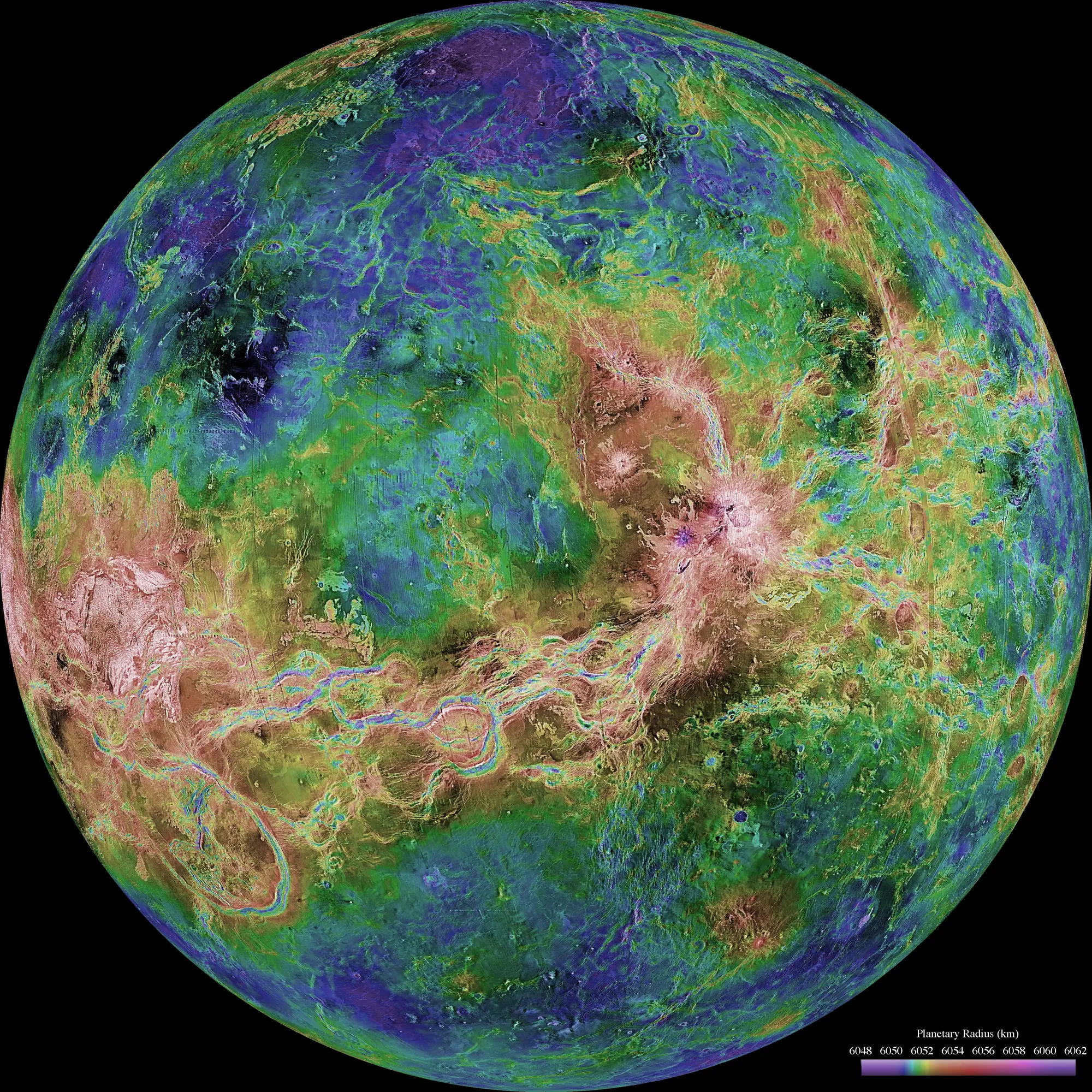
Radar-derived hemispheric view of Venus showing detailed surface terrain that is hidden beneath the planet's opaque cloud cover.

Magellan radar made the cloud-hidden surface of Venus globally visible. This hemispheric mosaic is derived mainly from radar imagery and is color-coded to emphasize terrain and elevation; it is not a natural-color optical photograph of the surface.

NASA/JPL/USGSNASA Science / Photojournal: View source ↗See source for rightsConverted for web display

Venus resembles Earth in size and mass, but its global cloud cover hid the surface from ordinary telescopes. That combination left room for a wide range of pre-space-age models.

Some scientists and popular writers imagined a humid, oceanic, or even swamp-like world beneath the clouds. Others already suspected much hotter conditions, so there was never one uniform “Venus jungle” consensus.

Radio observations increasingly pointed toward extreme temperatures.

Mariner 2’s 1962 flyby confirmed that Venus was extraordinarily hot, and later Soviet Venera landers directly measured a surface with crushing pressure and temperatures around 465°C.

The dense carbon-dioxide atmosphere produces a powerful greenhouse effect, while the surface is dry and hostile by terrestrial standards.

Venus remains Earth’s closest planetary analogue in size and bulk composition, which is exactly what makes the contrast scientifically important.

The overturned claim is the broader expectation that the cloud-hidden surface could be mild and broadly Earth-like—not that every astronomer specifically predicted oceans or vegetation.

Evidence

Sources and what they establish

Current evidence

  • Venus: FactsNASA Science

    Describes Venus's extreme surface temperature, pressure, and carbon-dioxide atmosphere.

Historical context

  • Mariner 2NASA Science

    Explains that the 1962 flyby confirmed a very hot Venus and overturned Earth-like expectations.

Previous belief

  • The Exploration of VenusNASA Goddard Space Flight Center

    Reviews the transition from speculative cloud-covered surface models to spacecraft measurements.

Related entries

Or go somewhere else: