Not a fact anymore

Ice sheets are static blocks of ice resting motionless on the land.

What we know now

Ice sheets flow under their own weight. Ice moves from the interior toward fast-flowing outlet glaciers and ice streams, while snowfall, melting, fracture, and ocean interaction continually change the system.

Why it changed

Their size and apparently fixed surface made ice sheets look immobile on human timescales. Surveying, satellite radar, GPS, boreholes, and remote sensing measured internal deformation and rapid flow.

Status
Overturned
Category
Earth Science
Accepted for
≈107 years
Accepted approximately
Before modern glaciological measurement
Changed approximately
20th century–present
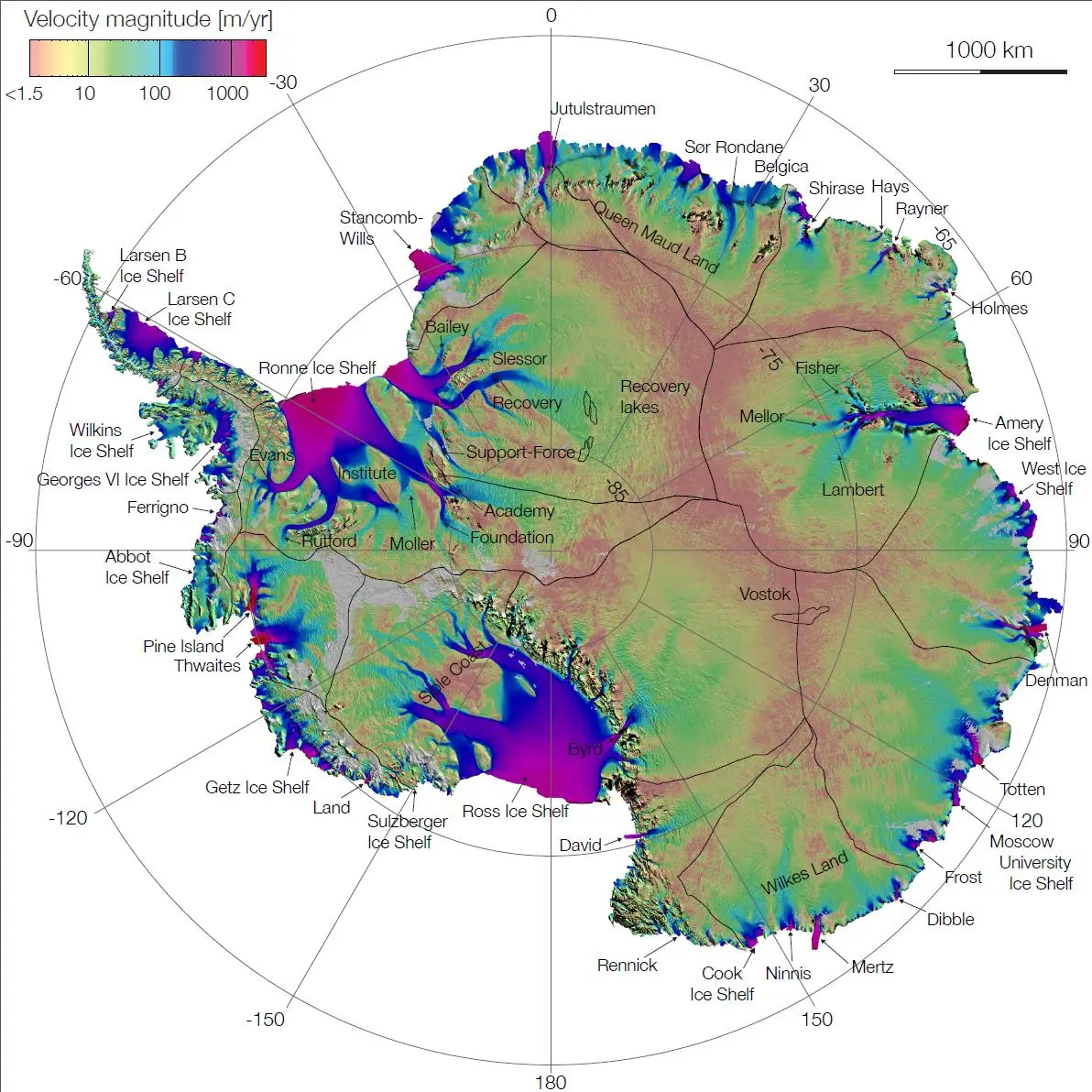
Satellite-derived map of Antarctic ice-flow speed and direction. Networks of faster-flowing ice streams extend from the continental interior toward the coast.

Satellite radar measurements make Antarctic ice motion visible at continental scale. Slow interior ice feeds networks of faster ice streams and outlet glaciers toward the coast, contradicting the mental model of an immobile block resting on land.

NASA/JPL-Caltech/UCINASA/JPL Photojournal: View source ↗See source for rightsConverted for web display

A polar ice sheet looks immovable. Its surface can extend beyond the horizon, and even a few meters of annual movement is invisible without fixed reference points. That scale made it easy to imagine the great ice masses as blocks simply resting on bedrock.

Glaciology showed that solid ice flows. Under the enormous pressure created by its own weight, ice deforms internally and moves outward from high interior regions. Where basal conditions and topography allow, ice streams and outlet glaciers can move far faster than the surrounding ice.

Survey markers provided early measurements of motion. Later radar, boreholes, GPS and satellite observations mapped both surface velocity and structures deep inside the ice, revealing drainage networks that continually transfer mass from the interior toward the margins and ocean.

An ice sheet is therefore a dynamic system balancing snowfall, internal flow, melting, fracture and iceberg calving. Changes at the edges can alter flow far inland.

“Flow” does not mean the ice has become liquid water. Most of the sheet remains solid and may move only slowly. The correction is that apparent stillness on a human timescale is not physical immobility.

Evidence

Sources and what they establish

Previous belief

  • Understanding iceBritish Antarctic Survey

    Directly contrasts the static-block picture with the internal dynamics of modern ice sheets.

Current evidence

  • Understanding iceBritish Antarctic Survey

    Describes slow-moving interior ice and fast-flowing glaciers that drain ice sheets.

Historical context

Related entries

Or go somewhere else: