Not a fact anymore

Every crystal must have a periodically repeating atomic pattern.

What we know now

A crystal can be highly ordered without repeating the same atomic pattern over and over. Quasicrystals have this nonrepeating order, yet they still produce the sharp diffraction patterns characteristic of crystals.

Why it changed

Classical crystallography treated periodic repetition as part of what made a crystal a crystal. In 1982, Dan Shechtman saw an electron-diffraction pattern from an aluminium–manganese alloy with a symmetry that an ordinary repeating crystal could not produce. The result led to the recognition of quasicrystals.

Status
Superseded
Category
Materials Science
Accepted for
≈132 years
Accepted approximately
19th century–1982
Changed approximately
1982–1992
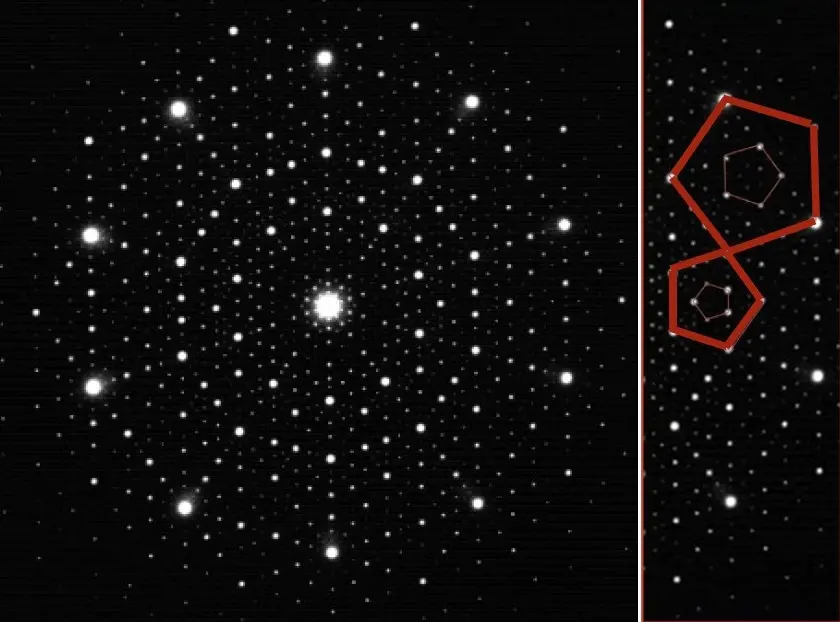
Electron-diffraction patterns from quasicrystals, appearing as sharp arrays of bright spots around a central beam, with fivefold and tenfold rotational symmetry highlighted.

Electron diffraction from quasicrystals with fivefold and tenfold symmetry—symmetries that an ordinary periodically repeating crystal cannot produce. The sharp spots show strong long-range order; the unusual symmetry helped reveal that crystalline order does not require periodic repetition.

D. Shechtman / NISTNIST: View source ↗See source for rightsConverted for web display

A familiar crystal can be pictured as a three-dimensional wallpaper pattern: one small arrangement of atoms repeats again and again through the material. For a long time, that kind of periodic repetition was part of the definition of a crystal.

In 1982, Dan Shechtman examined an aluminium–manganese alloy using electron diffraction. Electrons scattered from the atoms produced a pattern that revealed how regularly those atoms were arranged. Shechtman saw sharp, orderly spots, so the material clearly had strong internal order. But the pattern had a symmetry that an ordinary repeating crystal could not produce.

The result was initially difficult to accept because it seemed to violate the rules of crystallography. Other experiments reproduced it, and researchers showed that atoms can form structures that are ordered across long distances without ever repeating the same pattern periodically.

These materials became known as quasicrystals. They are not disordered like glass; their atoms follow a precise arrangement. The discovery changed the definition of a crystal by showing that long-range order does not require periodic repetition.

Evidence

Sources and what they establish

Previous belief

Current evidence

  • Dan Shechtman – FactsThe Nobel Prize

    Describes the nonrepeating but regular diffraction pattern that established quasicrystals.

Historical context

Related entries

Or go somewhere else: