Not a fact anymore

Earth's entire metallic core is liquid.

What we know now

Earth's core has two main layers: a liquid outer core surrounding a solid inner core. Earthquake waves reveal the difference because different kinds of seismic waves travel differently through solids and liquids.

Why it changed

Early seismology showed that shear waves do not pass through a large region of the core, establishing that much of it is liquid. In 1936, Inge Lehmann found faint earthquake-wave arrivals that a completely liquid core could not explain and proposed a smaller inner core at Earth's center. Later seismology showed that this inner core is solid.

Status
Narrowed
Category
Earth Science
Accepted for
≈21 years
Accepted approximately
Early 20th century–1936
Changed approximately
1936–1970s
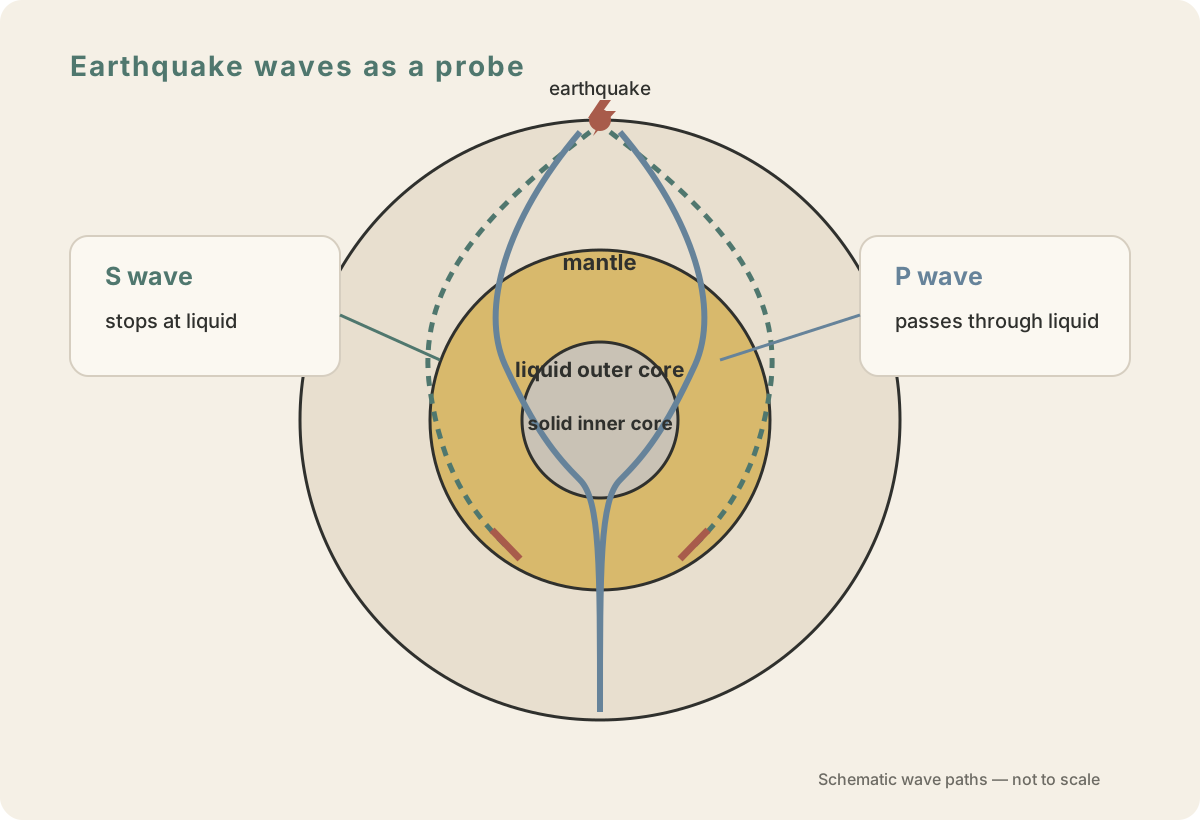
Schematic cross-section of Earth showing S waves stopping at the liquid outer core while P waves pass through the core and are refracted, with a solid inner core at the center.

Earthquake waves act like a probe of Earth's interior. S waves cannot travel through the liquid outer core, while P waves can pass through it and bend as their speed changes. Subtle P-wave arrivals that a completely liquid core could not explain led Inge Lehmann to propose an inner core in 1936; later seismology established that the inner core is solid. Wave paths here are simplified and not to scale.

Original graphic: Not a Fact AnymoreOriginal graphic

Seismologists cannot see Earth’s core directly, but earthquake waves let them probe it.

One important clue comes from shear waves, or S-waves. These waves can travel through solid rock but not through liquid. Their disappearance on the far side of Earth showed that a large region deep inside the planet is liquid, and for a time it was reasonable to picture the metallic core as liquid throughout.

Some earthquake waves did not fit that simple picture. In 1936, Danish seismologist Inge Lehmann studied faint signals reaching places where a completely liquid core should have produced a deeper shadow. She proposed that the waves were being reflected and bent by a smaller body at the very center of Earth.

Later observations confirmed the basic structure: a liquid outer core surrounds a solid inner core.

The inner core is not solid because it is cool. Its temperature is comparable to the surface of the Sun. It remains solid because the enormous pressure at Earth’s center raises the melting point of its iron-rich material.

The old model was therefore only partly wrong. Much of the core really is liquid; the correction was the discovery of a solid center inside it.

Evidence

Sources and what they establish

Primary research

  • P′Bureau Central Séismologique International

    Inge Lehmann's 1936 paper proposed an inner core to explain seismic observations.

Historical context

Current evidence

Related entries

Or go somewhere else: