Not a fact anymore

Atmospheric temperature always decreases as altitude increases.

What we know now

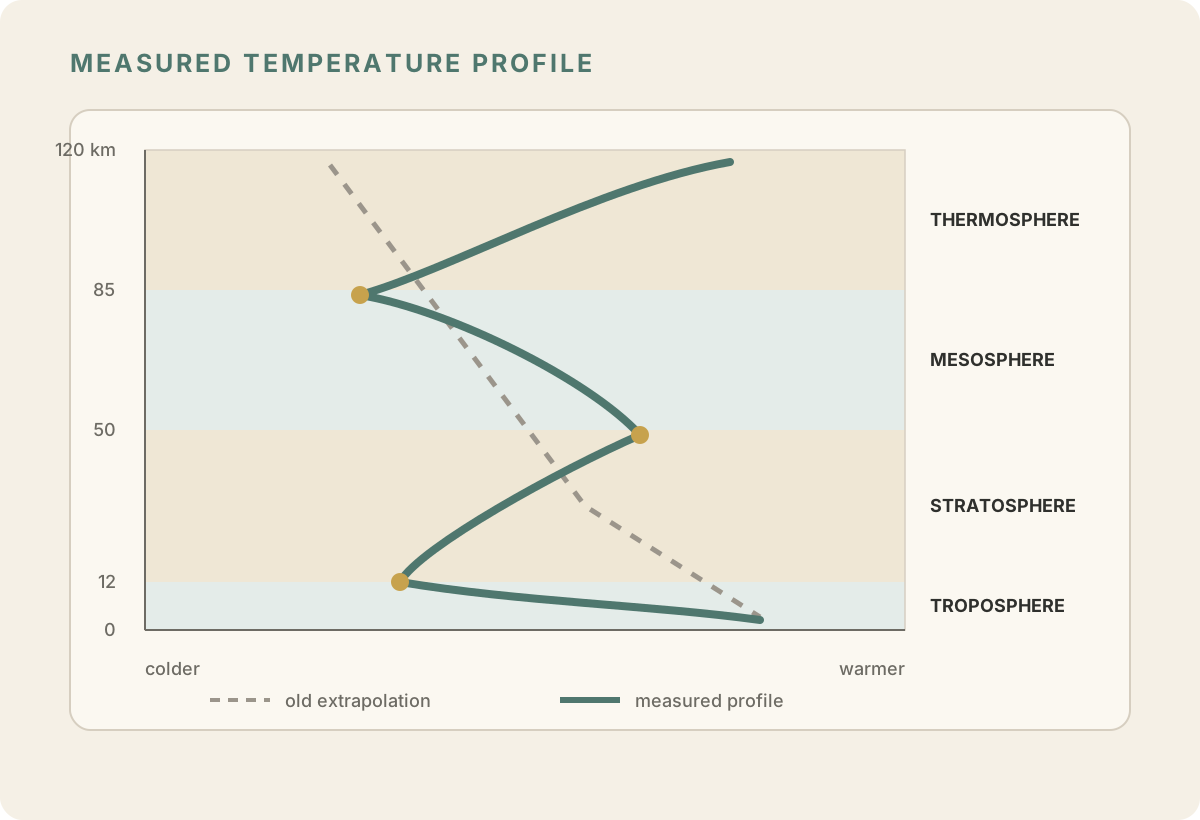
Temperature does not keep falling all the way up through the atmosphere. It usually decreases through the troposphere, the lowest layer where most weather occurs, but begins rising through much of the stratosphere because ozone absorbs ultraviolet sunlight and converts some of that energy to heat.

Why it changed

Mountains and early balloon measurements both showed cooling with height, so it was easy to extend that pattern upward. Around 1902, high-altitude balloons flown by Léon Teisserenc de Bort and Richard Assmann independently showed that the cooling stopped roughly 10–15 kilometres above the surface.

Status
Overturned
Category
Atmospheric Science
Accepted for
≈69 years
Accepted approximately
19th century–1902
Changed approximately
1902–1930s
Schematic temperature profile through Earth's atmosphere. A dashed line shows the old assumption of continuous cooling with altitude, while the measured profile cools in the troposphere, warms in the stratosphere, cools in the mesosphere, and warms again in the thermosphere.

A schematic temperature profile shows why the simple rule fails. Temperature generally falls through the troposphere, rises through much of the stratosphere, falls again through the mesosphere, and rises through the thermosphere. The curve is explanatory rather than a precise atmospheric sounding.

Original graphic: Not a Fact AnymoreOriginal graphic

Near Earth’s surface, going higher usually means getting colder. Mountains are colder than nearby lowlands, and nineteenth-century balloon measurements found the same pattern through the lower atmosphere.

It was natural to assume that the cooling simply continued upward.

Around 1902, Léon Teisserenc de Bort in France and Richard Assmann in Germany independently sent instrumented balloons high enough to test that assumption. At roughly 10–15 kilometres above the surface, the steady cooling stopped.

That boundary separates the troposphere, the lowest atmospheric layer where most weather occurs, from the stratosphere above it. Through much of the stratosphere, temperature rises with altitude instead of falling. Ozone absorbs ultraviolet radiation from the Sun and converts some of that energy into heat.

Higher still, the direction changes again: temperature falls through the mesosphere and rises through the thermosphere.

The atmosphere is therefore divided into layers partly by these temperature changes. Cooling with height remains a useful rule in the troposphere, but it is not a rule for the atmosphere as a whole.

Evidence

Sources and what they establish

Historical context

Current evidence

  • The StratosphereUCAR Center for Science Education

    Explains why temperatures increase upward through the stratosphere.

  • Layers of Earth's AtmosphereNASA

    Summarizes the temperature-defined atmospheric layers and their reversals.

Related entries

Or go somewhere else: