Not a fact anymore

Adult human heart-muscle cells are permanently post-mitotic and are never replaced.

What we know now

Adult human heart-muscle cells, called cardiomyocytes, do renew, but very slowly. Estimates suggest that roughly 1% are replaced each year in younger adults, with the rate falling with age. That is far too little to rebuild the large amount of muscle lost in a major heart attack.

Why it changed

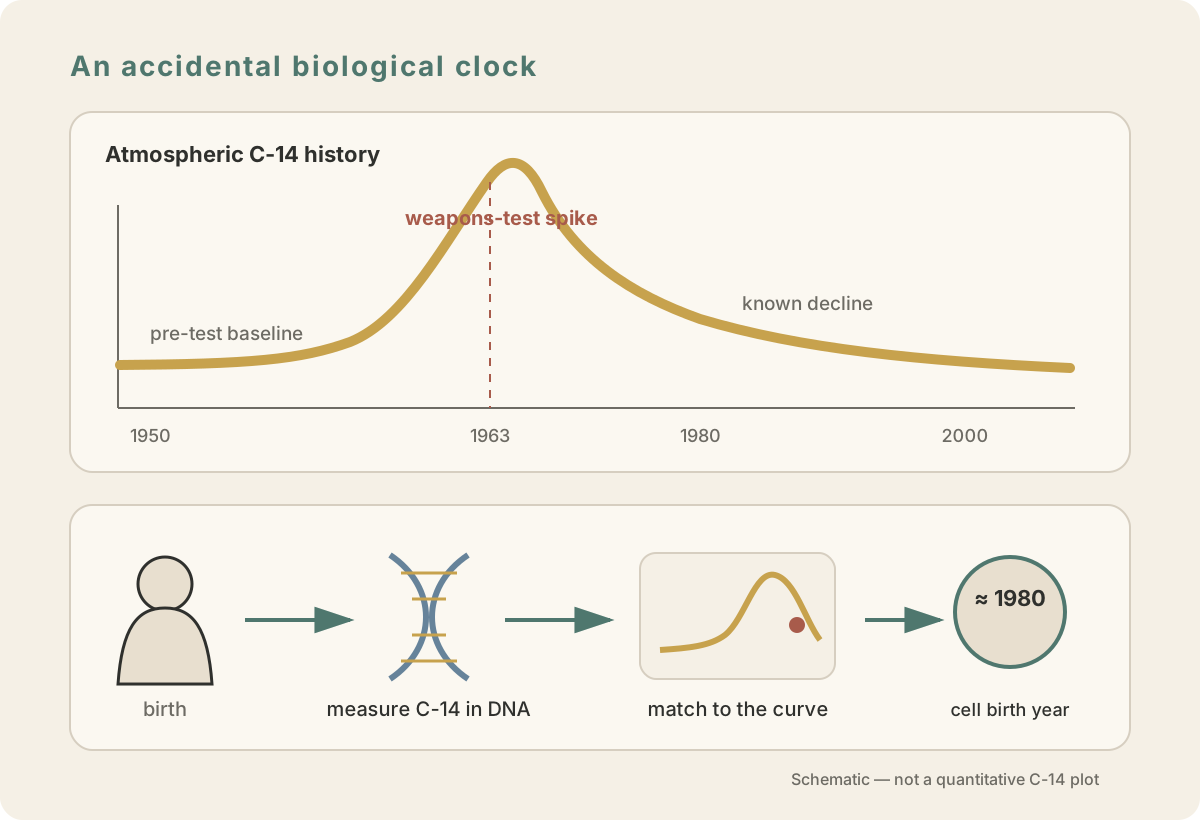
The turnover was too slow to observe easily. Researchers eventually used carbon-14 left in the atmosphere by Cold War nuclear tests as a time stamp: newly formed cells incorporated the carbon level present when their DNA was made. This showed that some adult heart-muscle cells were younger than the person carrying them.

Status
Overturned
Category
Medicine
Accepted for
Not quantified
Accepted approximately
Much of the 20th century
Changed approximately
Late 20th century–2000s
Schematic showing the atmospheric carbon-14 spike from nuclear weapons testing and how carbon-14 measured in heart-cell DNA can be matched to the known atmospheric curve to estimate when a cell formed.

Cold War nuclear testing accidentally created a biological timestamp. Atmospheric carbon-14 rose sharply and then declined along a well-measured curve. Because newly made DNA incorporates carbon from its time of formation, researchers could compare carbon-14 in cardiomyocyte DNA with that curve and estimate when the cells were born. The curve shown here is schematic, not a quantitative carbon-14 record.

Original graphic: Not a Fact AnymoreOriginal graphic

For most of the twentieth century, adult heart-muscle cells were thought to be permanent. Once development was complete, cardiomyocytes were expected to last for life rather than divide and be replaced.

That seemed consistent with what happens after a major heart attack. Dead heart muscle is largely replaced by scar tissue instead of being rebuilt as new working muscle.

The problem was that extremely slow cell renewal is difficult to measure in a living human heart. Researchers found an unusual clock in atmospheric carbon-14. Above-ground nuclear tests during the Cold War caused a sharp, well-dated rise in carbon-14 in the atmosphere. When a cell makes new DNA, it incorporates carbon from that time.

By measuring carbon-14 in the DNA of heart-muscle cells and comparing it with the atmospheric record, researchers could estimate when those cells were formed. In 2009, this showed that some adult cardiomyocytes were younger than the people carrying them.

The estimated renewal rate is low—about 1% per year in younger adults and less with age—and exact estimates vary. That is enough to overturn the claim of no renewal, but nowhere near enough to regenerate the muscle lost in a major heart attack.

Evidence

Sources and what they establish

Previous belief

Primary research

Current evidence

Related entries

Or go somewhere else: