Not a fact anymore

White light is a simple, uniform kind of light, while prisms and other transparent bodies create or modify the colors seen in a spectrum.

What we know now

White light can contain a mixture of wavelengths. A prism separates different wavelengths because the refractive index depends on wavelength; it does not manufacture the spectral colors from otherwise colorless light.

Why it changed

Newton's prism experiments showed that differently colored rays have different refrangibilities and that separated colors can be recombined to make white light. His two-prism experiments were designed to show that the colors were properties of the incoming light rather than irregularities produced by the glass.

Status
Overturned
Category
Physics
Accepted for
Not quantified
Accepted approximately
Pre-Newtonian optical theories, especially 17th century
Changed approximately
1666–1672
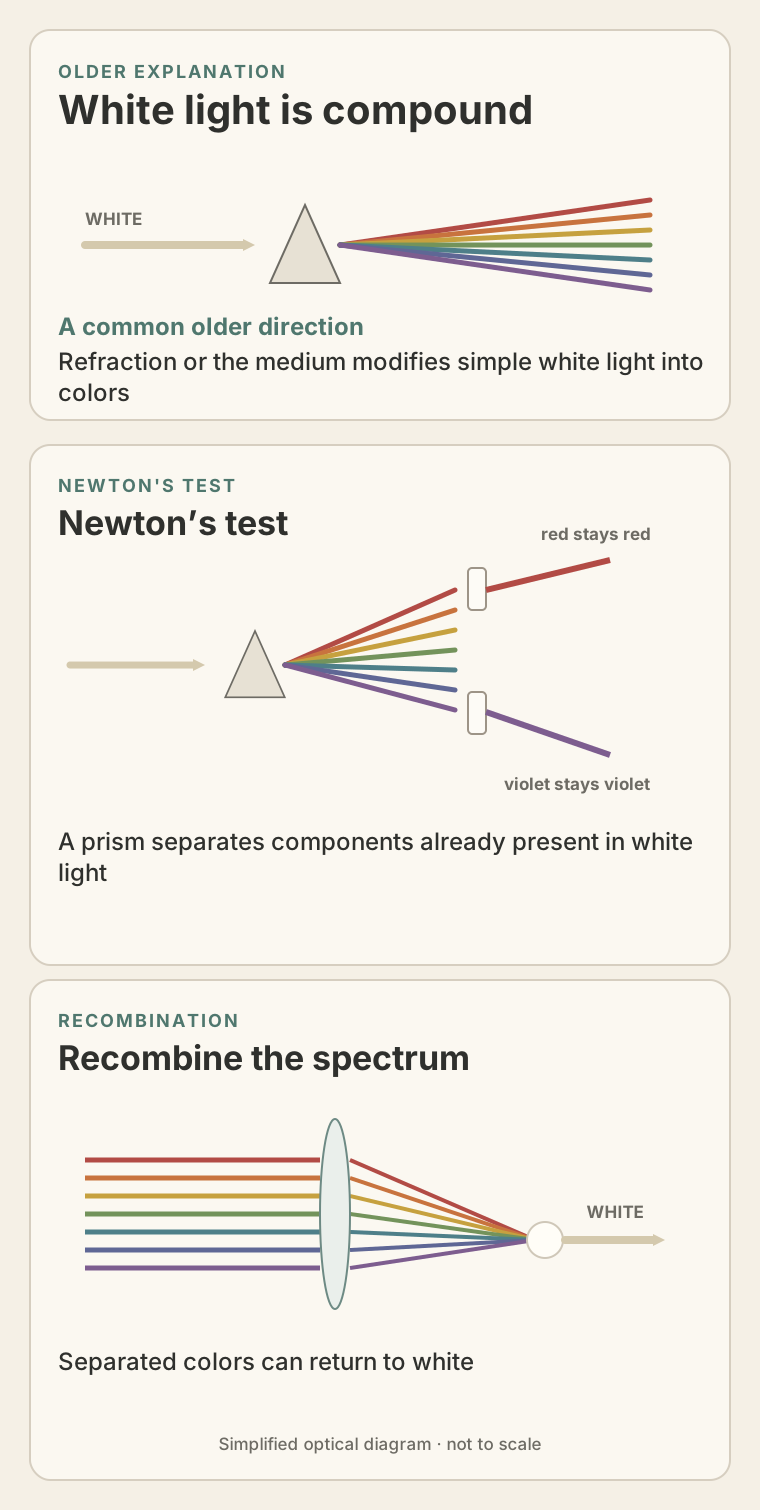
Two-stage diagram. White light enters a prism and spreads into a spectrum from red to violet. In the second stage, the separated colors are brought back together and emerge as white light, illustrating separation and recombination.

Newton’s prism experiments reversed a common older direction of explanation. A prism separates white light into differently refracted colors, and those colors can be recombined into white: the spectrum reflects components of the incoming light rather than colors simply manufactured by the glass.

Original graphic: Not a Fact AnymoreOriginal graphic

Newton’s color theory reversed the direction of explanation.

A prism had long been known to produce colored fringes. The natural assumption was that white light was the simple starting material and that refraction, glass, shadow, or some interaction in the medium modified it into colors. Seventeenth-century optical theories differed in their mechanisms, so there was no single universal pre-Newton theory.

Newton’s experiments made a different claim: the prism was sorting light that was already heterogeneous. His famous experimentum crucis selected one narrow part of a first prism’s spectrum and refracted it again. A red ray remained characteristically red and refracted by a different amount from a violet one. Repeated refraction did not turn each color into an arbitrary new set.

He then attacked the problem from the opposite direction. If white light is a mixture, separated spectral colors should be capable of recombination. Newton used lenses and prisms to bring them back together and recover white.

The result was conceptually strange: white, which looks visually simple, is optically compound; individual spectral colors can be more homogeneous.

Newton’s interpretation was controversial and took decades to secure broad acceptance. Because the pre-Newtonian theories were diverse rather than one sharply bounded consensus, this entry is excluded from precise lifespan statistics.

Evidence

Sources and what they establish

Historical context

Previous belief

Current evidence

  • Newton's OpticsOxford Handbook of the History of Physics

    Historical overview identifying Newton's theory of color and the compound nature of sunlight as central to modern optics.

Related entries

Or go somewhere else: