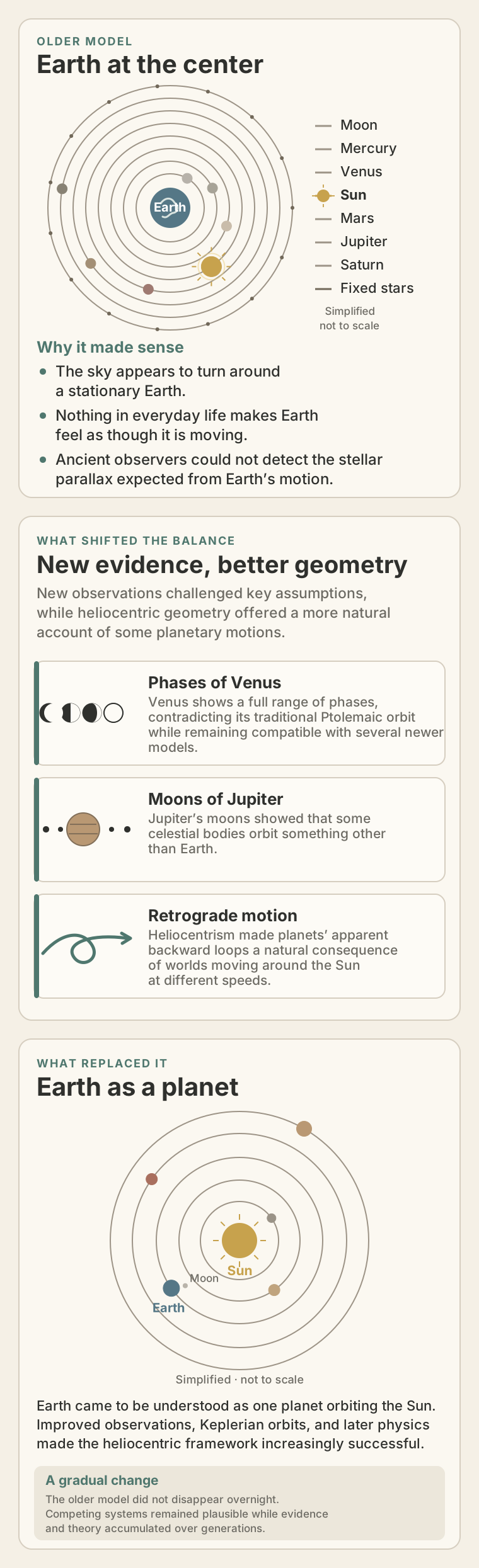
Ptolemaic geocentrism deserves more credit than the cartoon version of “people thought everything went around Earth.” Claudius Ptolemy, working in Alexandria in the second century CE, built a mathematical model capable of predicting planetary positions. His Almagest compiled earlier Greek observations and geometry into a system of deferents, epicycles, and other constructions that could be used computationally.
That predictive success is a major reason the model lasted. For more than a millennium the Almagest served as a foundational astronomical text. Its survival also depended on transmission and improvement: Greek astronomy was preserved, criticized, translated, and extended by scholars working in Byzantine and Islamic traditions before becoming central again in Latin European astronomy.
Copernicus’s 1543 heliocentric system rearranged the geometry but initially retained circular motions and epicycles. The decisive 17th-century transformation came from several directions at once: Galileo’s telescopic observations revealed phases of Venus and moons orbiting Jupiter; Kepler replaced circular planetary paths with ellipses; Newton later supplied a common dynamical explanation through gravity.
The transition cannot be reduced to “Ptolemy was foolish and Copernicus was right.” The old model was a technically impressive predictive achievement built from the observations and mathematical tools available at the time. What changed was the evidence, the geometry, and eventually the underlying physics.