Not a fact anymore

Dinosaurs were treated as an entirely extinct group, separate from living birds.

What we know now

Non-avian dinosaurs became extinct about 66 million years ago, but one dinosaur lineage survived: birds. In modern phylogenetic classification, birds are living avian dinosaurs.

Why it changed

Anatomical work revived the dinosaurian origin of birds in the 20th century, and cladistic analyses placed birds within theropod dinosaurs. Later feathered fossils provided striking additional evidence for that evolutionary relationship.

Status
Reclassified
Category
Paleontology
Accepted for
Not quantified
Accepted approximately
19th century–late 20th century
Changed approximately
1970s–1990s
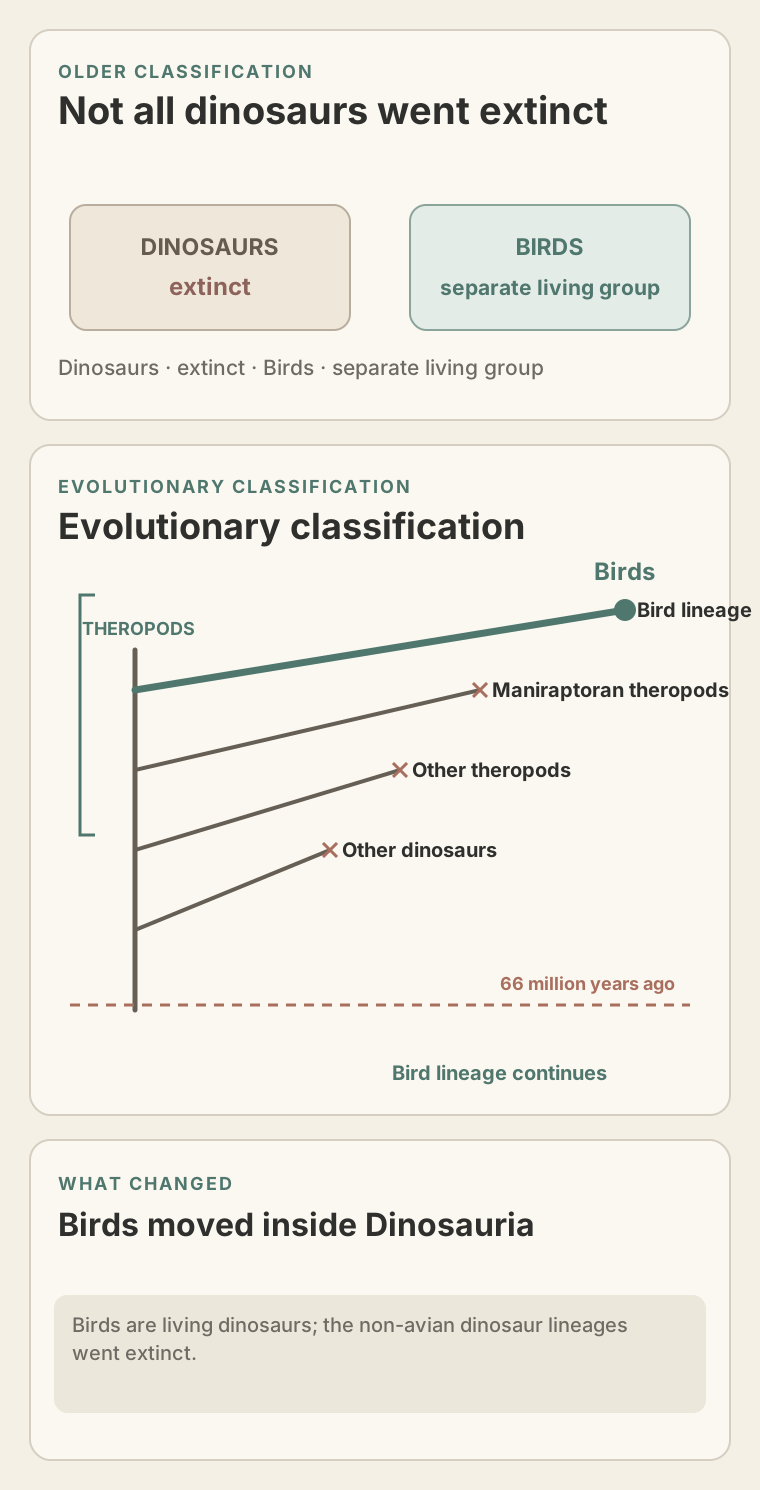
Simplified evolutionary tree showing several dinosaur branches, with birds branching from within theropod dinosaurs rather than outside Dinosauria. The non-avian dinosaur branches end at the end-Cretaceous extinction boundary while the bird branch continues to the present.

In evolutionary classification, birds do not sit beside dinosaurs as a separate surviving group. They branch from within theropod dinosaurs, which means the end-Cretaceous extinction eliminated the non-avian dinosaurs while one dinosaur lineage survived as birds.

Original graphic: Not a Fact AnymoreOriginal graphic

The first Archaeopteryx fossils in the 1860s already gave birds an unmistakably reptilian-looking relative, and Thomas Henry Huxley argued that birds were closely connected to dinosaurs. But that idea did not become the standard classification. For much of the 20th century, dinosaurs remained an extinct reptile group in textbooks and museum displays, while birds occupied a separate class.

The modern connection revived with detailed anatomical work on small theropod dinosaurs, especially John Ostrom’s studies of Deinonychus beginning in the late 1960s. Shared features of the limbs, hips, shoulders, and skeleton made a dinosaurian origin of birds increasingly persuasive. Cladistics then changed the classification itself: Jacques Gauthier’s 1986 analysis placed birds within theropod dinosaurs rather than alongside them as a separate evolutionary branch.

Discoveries of feathered non-avian dinosaurs later made the relationship visually dramatic, but the essential change was phylogenetic. The end-Cretaceous extinction still eliminated every non-avian dinosaur lineage. Birds survived from within Dinosauria, so in modern evolutionary classification the group is not wholly extinct.

Evidence

Sources and what they establish

Current evidence

  • Birds are DinosaursSmithsonian National Museum of Natural History

    States that the ancestor of all birds was a dinosaur and that all birds are dinosaurs.

  • The Origin of BirdsUniversity of California Museum of Paleontology

    Reviews anatomical and fossil evidence placing birds within theropod dinosaurs.

Historical context

  • Could Dinosaurs Still Exist?Smithsonian Institution

    Explains that birds are living dinosaurs and that the extinction applies to non-avian dinosaur groups.

Primary research

  • Saurischian monophyly and the origin of birdsMemoirs of the California Academy of Sciences via Biodiversity Heritage Library

    Gauthier's 1986 cladistic analysis placed birds within theropod dinosaurs and provided a formal phylogenetic landmark for the modern classification.

Related entries

Or go somewhere else: